The Business Case for Training Providers: How to Differentiate What You Sell and Prove Its Value
If you sell training for a living, the market has changed. Buyers are more cautious. Budgets are tighter. And “great facilitation” is no longer enough to win or retain business. Clients want to know what happens after the workshop ends.
Did anything change?
Did behavior improve?
Did the training actually matter?
For training providers, this shift creates both pressure and opportunity.
The challenge training providers face
Most training providers deliver powerful live experiences. They bring expertise, energy, and credibility into the room. Participants are engaged. Feedback is positive.
Then the engagement ends.
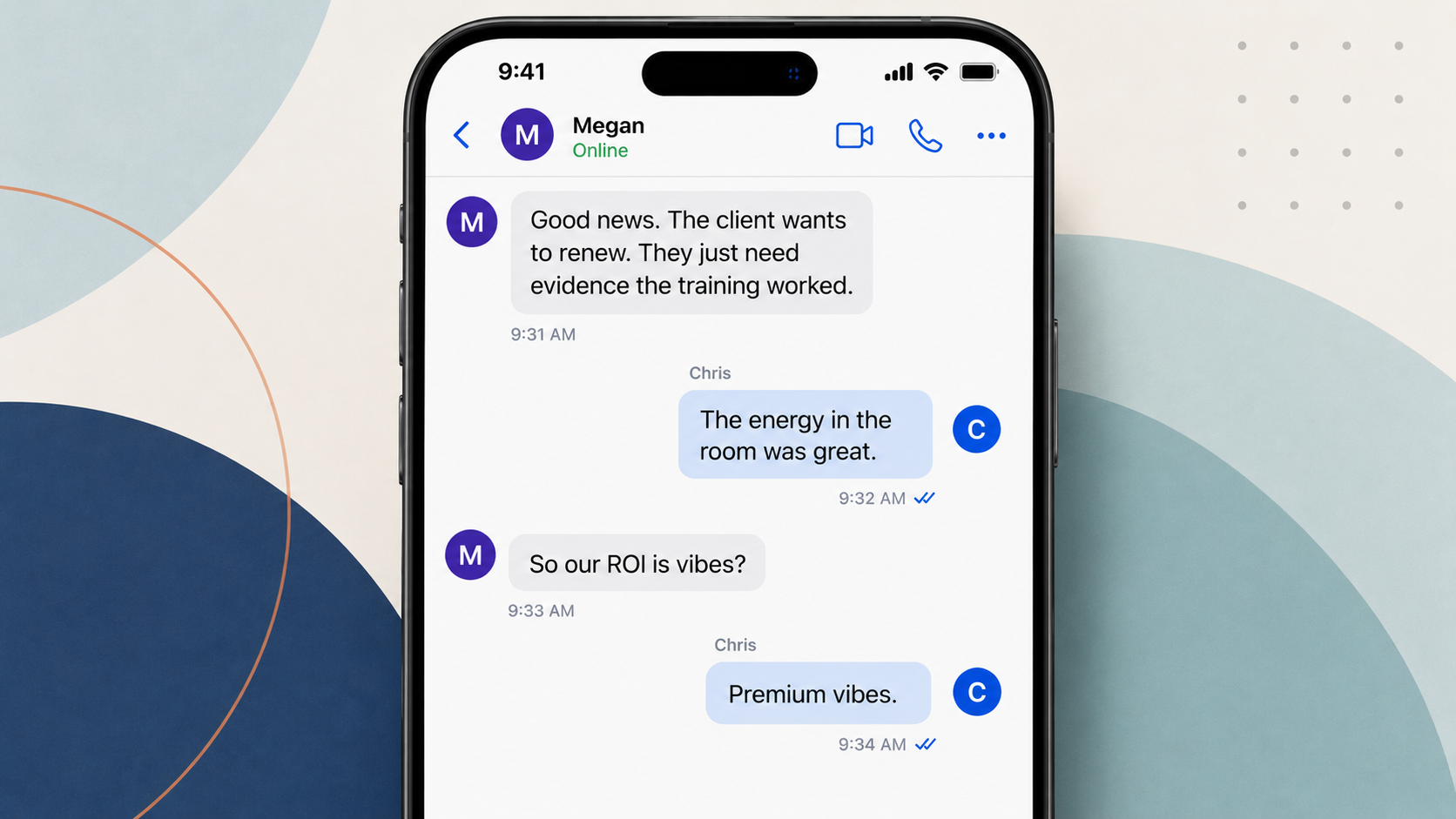
Weeks later, the buyer asks for evidence of impact, and the provider has very little to show beyond satisfaction scores and anecdotes. Even when the training genuinely helped, the value is hard to demonstrate. This creates a frustrating dynamic. Providers know their work matters, but they cannot easily prove it in the language buyers now expect.
Why differentiation is no longer optional
In a crowded market, training content alone is rarely a differentiator. Many firms cover similar topics, frameworks, and competencies. What buyers increasingly value is what happens after delivery.
Do learners retain the key concepts?
Are they applying the training on the job?
Can the provider demonstrate measurable progress?
Providers who can answer these questions stand out quickly. Those who cannot risk being treated as interchangeable.
Extending the value of training through continued exposure
One of the most underutilized opportunities for training providers is extended learner engagement. Live training creates the foundation. Reinforcement extends its shelf life. When learners continue to engage with key ideas through short, structured follow-ups, exposure increases without adding seat time. Concepts are revisited. Application is encouraged. Reflection deepens understanding.
This is where LIFTs, Learning Interventions Fueling Transformation, play a critical role.
Rather than adding more sessions, providers can offer a structured post-training journey that keeps learners connected to the material for weeks after delivery. This extended exposure reinforces the provider’s expertise while increasing the likelihood of real behavior change.
Turning reinforcement into a commercial advantage
Extended reinforcement does more than support learners. It strengthens the provider’s business model.
It creates a clear point of differentiation in proposals.
It adds value without requiring more live delivery time.
It deepens the provider’s relationship with both learners and buyers.
Most importantly, it generates data.
When learner reflections, engagement patterns, and application insights are captured over time, providers gain evidence that their training is working. This shifts conversations with buyers from opinion to insight.
Demonstrating ROI to training buyers
Training buyers are under pressure to justify spend internally. Providers who help them do that become strategic partners rather than vendors.
With reinforcement journeys in place, providers can show:
That learners retained key concepts after the session
That learners reflected on how to apply them
That behaviors changed in observable ways
This evidence supports renewal conversations, expansion opportunities, and long-term partnerships. At elevator9, this is exactly the gap we help training providers close. The platform allows providers to package reinforcement and analytics alongside their live training, turning a one-time event into a measurable learning journey.
From delivering training to delivering outcomes
The most successful training providers are shifting their identity.
They are not just selling sessions.
They are selling outcomes.
By extending engagement through LIFTs and providing credible evidence of impact, providers can move upstream in the value chain. Pricing conversations change. Buyer relationships deepen. Differentiation becomes defensible. In a market where buyers increasingly ask “What did this change?”, providers who can answer that question clearly will win.