
Liftology

A 25-episode series designed to empower you with practical insights from learning science, helping you elevate the effectiveness and impact of your training programs.
Introduction: learning science and improving people
Learning to adapt to things we didn’t evolve to handle may be one of the most important traits that sets humans apart. We can learn from others through courses, books, and many other sources. Yet learning isn’t always easy. In fact, for many skills it is quite complex. Our cognitive architecture evolved to learn some things naturally, while other things require much more effort. What separates the two, and what does it take to bridge the gap?
Liftology 2: The difference between behavior changes and skill shifts
A familiar challenge is behavior change. Nudges are a common tool for shaping new behaviors, focusing on altering responses to specific triggers. But lasting shifts in skill require a more sustained effort, both in design and over time. If you want to build a new capability, you need a different approach.

Liftology 3: How to make learning persistent
Learning in the brain is, at its core, the strengthening of connections between patterns of activation across many neurons. Whether it’s motor patterns in sports or the skills used in knowledge work, we activate patterns together and the links between them grow stronger, much like exercise builds strength over time. These links, however, can fade. With only one exposure, information may fade within hours. To create learning that leads to lasting change, we have to do more.

Liftology 4: The role of patterns of learning in doing
When we’re in a situation, our working memory forms a pattern of activation that represents that moment and brings related knowledge to mind. That knowledge consists of patterns stored in long-term memory. Our actions and decisions about which skills to use come from what is active in working memory. Developing a skill, then, means building meaningful patterns that activate in the right circumstances. Through learning, we link these patterns so the right responses emerge when they are needed.

Liftology 5: The role of reactivating in learning
To strengthen the connections between patterns in the brain, we have to activate those patterns together. But only so much strengthening can occur at once before the process needs to reset. Learning works more like drip irrigation than flooding. Small, repeated exposures are more effective than a single large one. The strengthening process also fatigues and needs time to recover. That is why sleep and repeated activation over time are necessary for learning to persist.

Liftology 6: The role of elaboration
To move information into long-term memory, we activate new information alongside related knowledge we already have. This elaboration increases the chances that the new information will be triggered later by what we already know. These connections may link to prior concepts or to personal experience. Repeatedly activating the information and connecting it to different but relevant knowledge further strengthens the pattern in long-term memory.
Liftology 7: The role of retrieval (using information)
To bring information back out of long-term memory, we have to reactivate it. Retrieval works best when it happens in contexts similar to where the knowledge will actually be used and when it is actively applied as a skill. Repeated retrieval practice across different situations and applications increases the chances the knowledge will be available when it is needed.
Liftology 8: Timing of reactivation
Newly formed memory connections can fade quickly without reactivation, and only so much strengthening can occur at once before the process needs rest. As a result, connections need to be reactivated within a relatively short period of time. Early on, no more than one to two days should pass before reactivation if a lasting skill shift is the goal. As the connections grow stronger, the interval can and should expand. Still, regular reactivation remains essential until the skills are firmly developed.
Liftology 9: The role of models
To support the application of knowledge, it helps to provide guidance about how the world works in a particular skill area. Conceptual, causal explanations give people a way to understand the consequences of different actions. These mental models create a frame of reference for making choices. Early models are often simple, with more complex ones introduced over time. They can guide specific actions at the right moment, such as “swing through the ball,” or explain consequences that shape decisions, such as “if I apply pressure here, it will affect that over there.”
Liftology 10: The role of examples
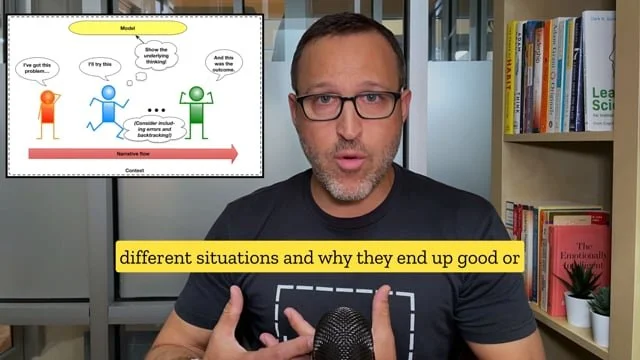
Causal explanations of how the world works are ideally abstract. To see how these mental models apply in different situations, we use examples. Examples show how the models are put into practice across varied contexts. Early examples build initial understanding, while additional ones help develop a richer and more flexible grasp of the skill. A well-chosen set of examples helps reveal the full range of where and how the skill can be applied.
Liftology 11: How We Begin
Overall, a learning journey includes the core event or events and the LIFTs that extend the learning afterward. What does it take to get this right? It begins with a clear focus for everything that’s created. From there, you need to determine what to build as the foundation and how to build on top of it. We’ve covered the basics, but now it’s time to bring the bigger picture together.
Liftology 12: The role of reconceptualization
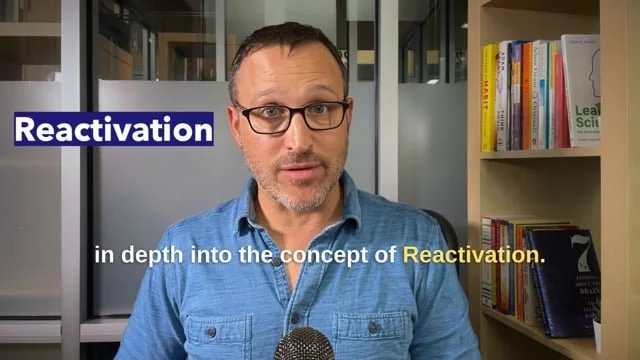
In many, if not most, cases, there are nuances that help elaborate an initial understanding. There may also be different ways to think about a skill, such as using a metaphor like muscle building to illustrate the need for repeated practice. Introducing new models over time can prompt the reactivation of relevant knowledge, strengthening connections and deepening learning. These new models can expand on the original, extending understanding and creating additional patterns that can be triggered, supporting richer ways to recognize and respond to situations.

Liftology 13: The role of recontextualization
In addition to new concepts, fresh examples are another way to prompt the reactivation and strengthening of connections that advance learning. As learners develop, they become ready for examples that reveal new nuances in situations and responses, helping them build additional facets of a skill. Expanding the breadth and depth of examples over time is therefore a powerful way to extend learning and support more effective outcomes.
Liftology 14: The role of reapplication
Not surprisingly, beyond new models and examples, one of the most powerful ways to reactivate and strengthen learning is to apply knowledge in new situations. While this can happen naturally through experience, structured practice is also valuable because feedback can be carefully designed. Asking questions that check understanding and the ability to apply a skill is another effective way to build capability.
Liftology 15: Coupling models, examples, and practice
When building prompts to support learning, it helps to use examples that show new aspects of a model and then provide practice that lets learners apply that idea. Understanding grows best when models, examples, and practice develop together. If you add a new nuance to a model, show it in one or more examples and then give learners a chance to practice it. This steady progression helps skills develop over time.
Liftology 16: Knowledge and mini-scenarios
A useful way to think about applying new skills is to consider both the knowledge required and the problems it must be used to solve. Questions can help prompt and check both. For example, recitation questions can confirm that key knowledge is in place. We can also present short situations and ask learners to choose between possible actions, essentially small single-decision scenarios. Even basic knowledge can and should be tested in context this way.
Liftology 17: Choices and Feedback
Once a learner has responded to a question, feedback becomes essential. There are important nuances here: most wrong answers are not random, but reflect specific misunderstandings. Good feedback should address those misconceptions directly rather than simply marking an answer as right or wrong. Learners make more progress when they understand why a choice was correct or incorrect.

Liftology 18: The role of reflection
Feedback is a form of reflection, and reflection more broadly helps solidify learning. It works by creating stronger connections between personal experience and the skill being developed. Asking learners to reflect on how the learning affects them helps extend those connections and reinforce the learning. For example, they might consider how the idea explains something they have seen before, or what they plan to do differently in the future. Both can be valuable.

Liftology 19: The role of asking about application in life
For skills we want people to develop, there should be opportunities to use them beyond the learning experience. After all, the goal is improved performance. Learners should be encouraged to apply the skills in real situations. However, feedback does not always happen unless it is prompted or arranged. One useful approach is to ask learners about how they used the skill and how they think it went. If feedback is possible, this creates an opportunity for it. Even without feedback, asking simple after-action questions helps reinforce the learning.

Liftology 20: The role of asking for impact reviews
A valuable way to reinforce learning is to focus not on the skills that they’re applying, but to evaluate the impact of the use of the skill on their life, their work, etc. If they are using these skills, ideally it’s having a positive effect or there’s a need for a shift in approach. This is an opportunity for feedback on the process and the topic, as well, if possible. Regardless, this check on the effect their skill use is a reactivation and creates the basis for self-monitoring skills, which then can become self-improvement. It can help to provide guidance about how to evaluate impact.