Retention Plus Engagement: How Learning Science Turns Training into Performance
If learning does not last, it does not matter how engaging it was.
And if learning is remembered but never applied, it still does not create value.
This is the tension at the heart of workplace learning. Retention without engagement leads to fragile knowledge. Engagement without retention leads to insight that never shows up on the job.
Learning science is clear on this point. Performance comes from the combination of retention and deep engagement, not from either one alone.
Why retention and engagement are often treated separately
Most training programs implicitly choose one side of this equation.
Some focus heavily on retention. They emphasize repetition, quizzes, and recall. Learners may remember the material, but struggle to translate it into action.
Others prioritize engagement. They rely on discussion, storytelling, and reflection. Learners feel connected to the ideas, but memory fades quickly without reinforcement.
Both approaches miss the mark on their own. Retention answers the question, “Can I access this information?” Engagement answers the question, “Do I understand this well enough to use it?”
Performance requires a yes to both.
Retrieval and generation in plain terms
Learning science gives us two complementary processes that explain how this works.
Retrieval happens when learners actively pull information from memory rather than re-reading it. Each time they do this, the memory becomes stronger and easier to access later. Retrieval is one of the most reliable ways to slow forgetting.
Generative processing happens when learners explain ideas in their own words, connect them to prior experience, or apply them to new situations. This is what deepens understanding and prepares learners to adapt knowledge to real work.
Retrieval strengthens memory.
Generative processing strengthens meaning.
When training designs rely on only one of these, learning stays incomplete.
Why live training alone cannot do both
Live training is excellent at sparking generative processing. Discussion, questions, and shared problem-solving help learners explore ideas and begin making sense of them. What live training is not good at is sustaining retrieval over time.
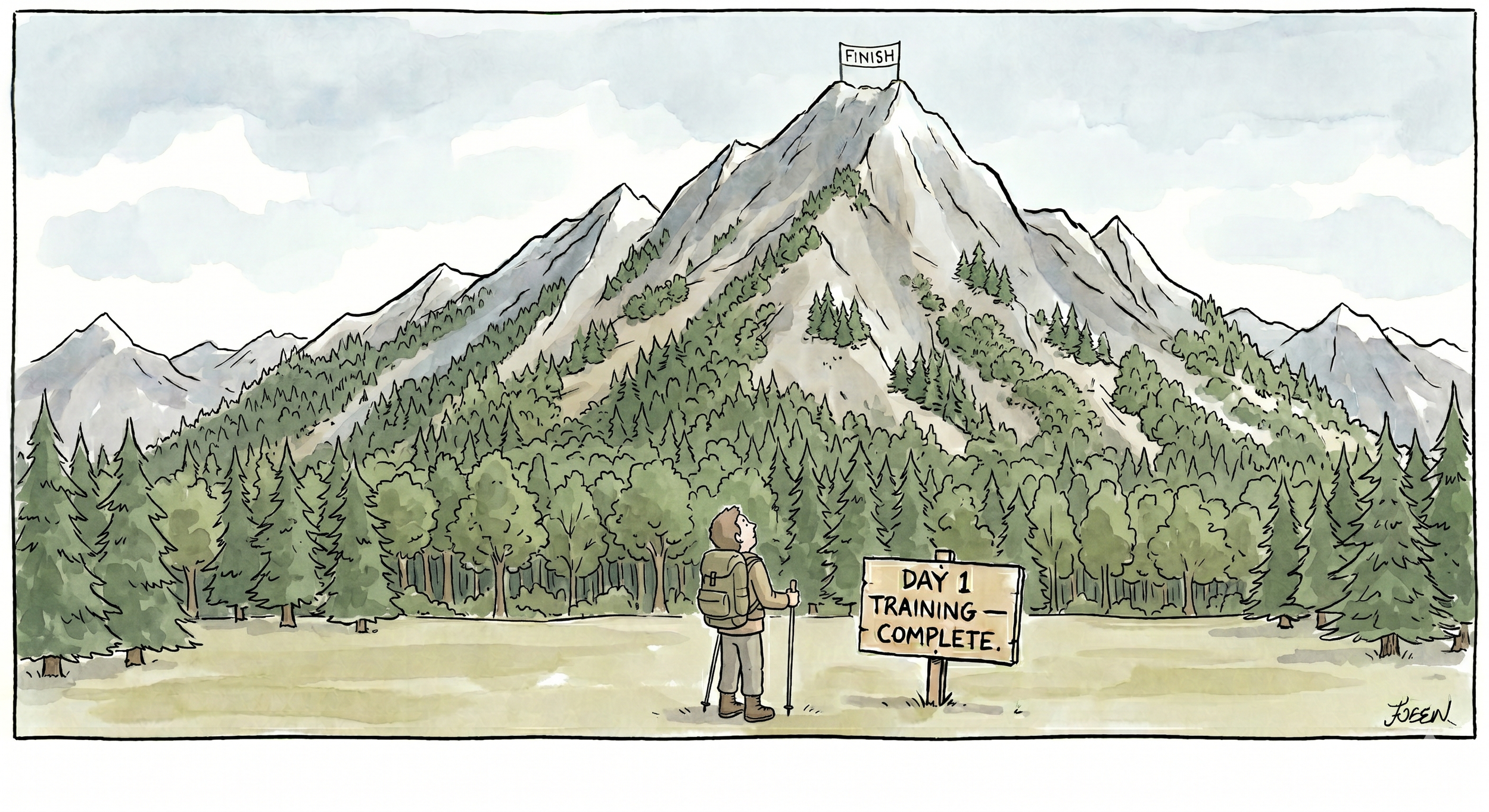
Once the session ends, opportunities to recall and apply learning usually disappear. Without deliberate reinforcement, memory fades and engagement loses its anchor. This is why even well-designed workshops often fail to produce lasting behavior change. The learning never gets a chance to consolidate.
Designing learning as a journey, not an event
To turn training into performance, we have to stop designing only for the moment of delivery.
Effective learning journeys do a few things consistently:
They prompt learners to recall key ideas after the session ends.
They ask learners to reflect on how those ideas apply to their own work.
They revisit concepts at spaced intervals, not all at once.
They create opportunities to move from understanding to action.
When retention and engagement are woven together over time, learning becomes durable and usable. This is where reinforcement stops being an add-on and starts being the core design principle.
Where this shows up in practice
In practice, this means post-training experiences should do more than remind learners what was covered.
They should ask questions like:
What stood out to you when you tried this at work?
What changed when you applied this approach?
Where did it feel difficult or unexpected?
These kinds of prompts require retrieval and generative thinking at the same time. They strengthen memory while pushing learning toward application.
At elevator9, this dual focus is intentional. Reinforcement is designed to preserve key concepts while also encouraging learners to integrate them into real work scenarios. That combination is what makes learning visible and measurable after the session ends.
Turning learning science into performance outcomes
When organizations design for both retention and engagement, the impact compounds.
Learners remember more.
They apply learning sooner.
Managers see clearer behavior change.
L&D teams gain credible evidence of impact.
Training stops being something people attend and starts being something they use.
Retention keeps learning accessible.
Engagement makes learning usable.
Together, they are what turn training into performance.
—--
If you want to keep exploring, we've got resources ready for you:
Want to go deeper? Explore our thinking:https://www.elevator9.com/the-9th-floor
And if you're ready to see how elevator9 helps organizations close the gap between training and real behavioral change — we'd love to show you.
👉 Book a demo: elevator9.com/contact