Six Proven Ways to Make Training Actually Stick

Most organizations already know that training alone is not enough.
What is less clear is what actually works once the session ends.
Learning science has been remarkably consistent on this point. Knowledge sticks when it is revisited, recalled, reflected on, and applied over time. When those elements are missing, even the best training fades quickly.
The good news is that making training stick does not require more content or longer programs. It requires better design.
Here are six proven strategies that consistently turn training into sustained capability.
1. Space learning instead of cramming it
Spacing works because memory strengthens through repeated activation over time, not through mass exposure.
When learners revisit key ideas across days or weeks, retention improves dramatically. This is true regardless of industry or role.
In practice, spacing means resisting the urge to put everything into a single session or a single follow-up. It means designing touchpoints that reintroduce learning when it is most likely to fade.
Spacing does not slow learning. It stabilizes it.
2. Require retrieval, not re-reading
Re-reading feels productive. It rarely is.
Memory strengthens when learners are asked to recall information from memory, not when they are shown it again. The effort involved in retrieval is what makes learning durable.
Simple prompts work best. Asking learners to explain a concept in their own words or describe how they would use it in a real scenario is often more effective than any quiz.
If learners are not struggling a little to recall, learning is probably not sticking.
3. Use small moments instead of big blocks
Learning fits better into work when it respects attention and time.
Micro engagements allow learners to reflect and apply ideas without stepping away from their responsibilities. Short prompts delivered at the right moment are far more effective than long modules delivered at the wrong one.
This is not about shrinking learning. It is about embedding it.
When learning fits into the flow of work, application becomes more likely.
4. Design for reflection, not just recall
Retention keeps information accessible. Reflection makes it usable.
Learners need space to connect new ideas to their own experience. Reflection prompts help them notice what changed, what worked, and what felt difficult when they tried something new.
These moments of sense-making are where deeper learning occurs. Without them, knowledge stays abstract and fragile.
Reflection is not a soft skill. It is a performance skill.
5. Involve managers to validate learning
Self-report tells part of the story. Workplace observation tells the rest.
When managers are involved in the learning process, training becomes anchored in real performance. Baselines and follow-ups help make progress visible and credible.
Manager involvement also sends a clear signal that learning matters. When leaders ask about application, learners are far more likely to prioritize it.
Learning does not happen in isolation. It happens in context.
6. Measure what matters after training ends
Attendance and satisfaction are easy to measure. Retention and application take more intention.
Organizations need ways to see whether learners are remembering key concepts, integrating them into their thinking, and applying them in their roles.
This requires combining reflection, simple quantitative signals, and workplace validation. When these pieces come together, learning stops being assumed and starts being demonstrated.
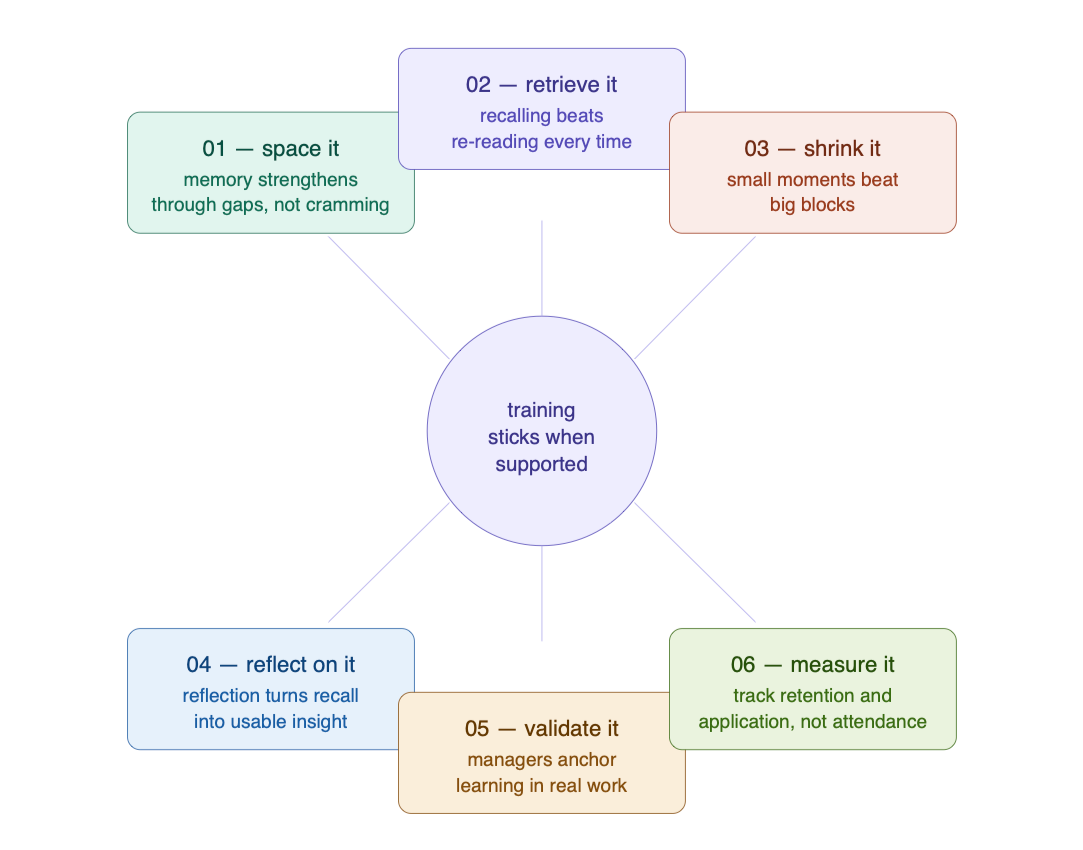
None of these tactics require more content. They require better follow-through
Bringing it all together
None of these strategies are new. What is new is the ability to integrate them into live training reinforcement without adding friction.
At elevator9, these principles shape how reinforcement journeys are designed. Spaced prompts encourage retrieval. Reflection supports integration. Manager input validates application. Analytics make progress visible.
When these elements work together, training changes character.
Learners remember more.
They apply learning sooner.
Organizations gain confidence in their investment.
Training sticks not because it was memorable, but because it was supported.
—--
If you want to keep exploring, we've got resources ready for you:
📚 Thought leadership & white papers: elevator9.com/thoughtleadership
🎬 Liftology video series: elevator9.com/liftology
And if you're ready to see how elevator9 helps organizations close the gap between training and real behavioral change — we'd love to show you.
👉 Book a demo: elevator9.com/contact